
Renovation | Former Bishop’s Curia Naumburg
"Zentrum Welterbe": An effortless eye-catcher
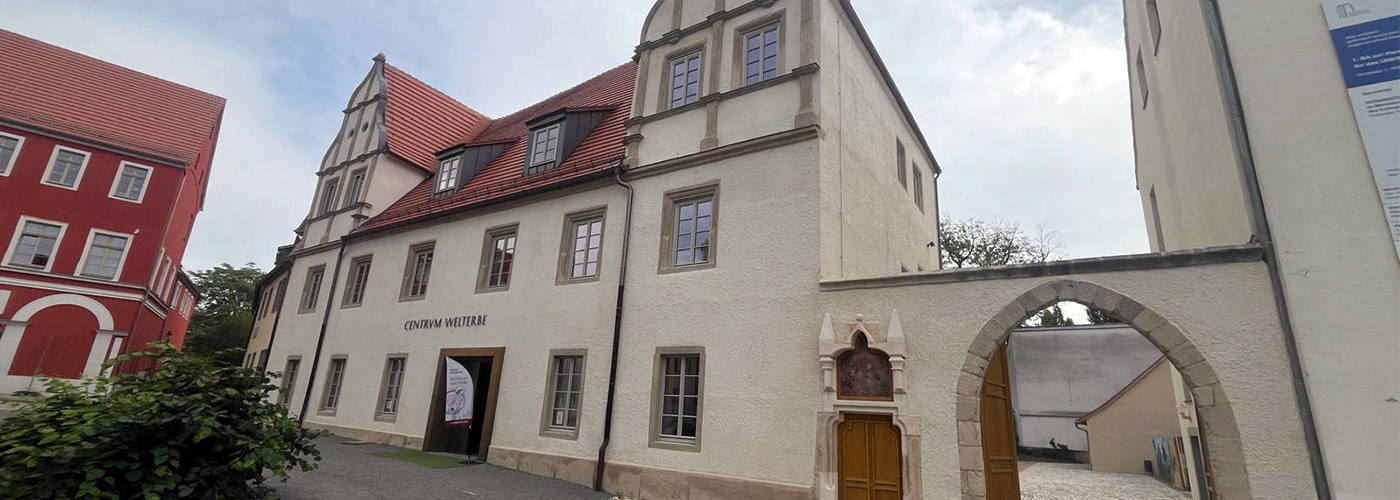
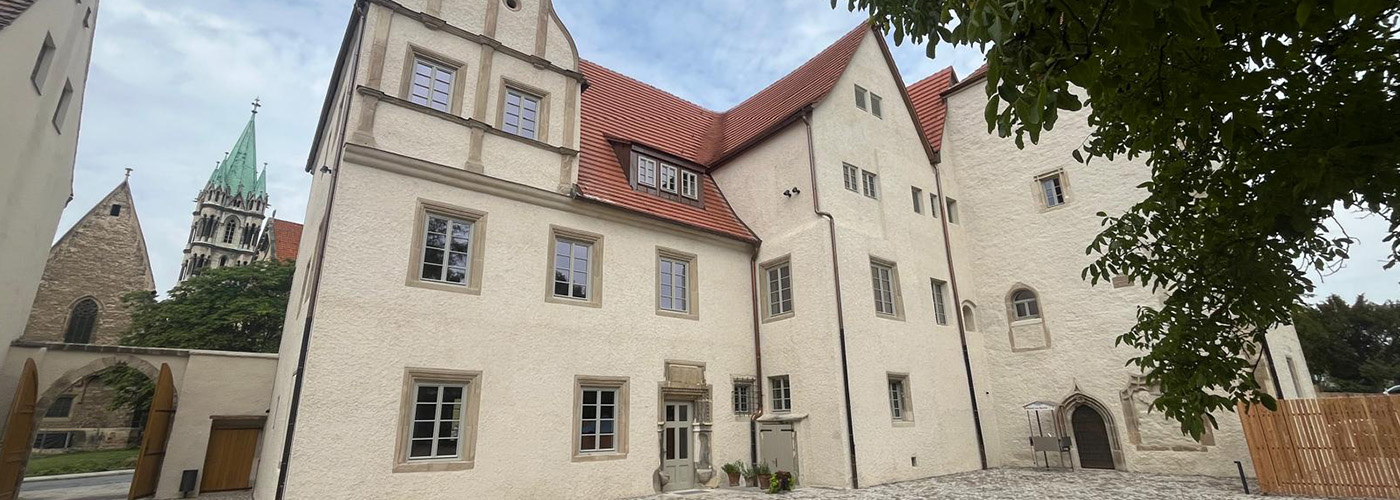
The Bishop’s Curia has been remodelled and repurposed several times over the past few centuries. Today, following its refurbishment, the building complex serves as a visitor information centre for the UNESCO World Heritage Site, Naumburg Cathedral, and includes a museum and events area. The heritage conservation authorities had deliberately rejected the idea of applying a coat of paint to the building. Over time, the weathering of the façade will cause the surfaces to age naturally, because buildings with such a rich historical background do not need to draw attention to themselves with bright plasterwork and colours.
A diverse and complex heritage
Naumburg Cathedral, a UNESCO World Heritage Site, stands prominently on Domplatz (Cathedral Square) in the centre of the town. Right next to it is another building of great historical value: the Naumburg Bishop’s Curia, with its Romanesque residential tower and curia garden. The main building of the curia, resembling a palace, was built in the 16th century under the last Catholic bishop, Julius Pflug, in the Renaissance style.
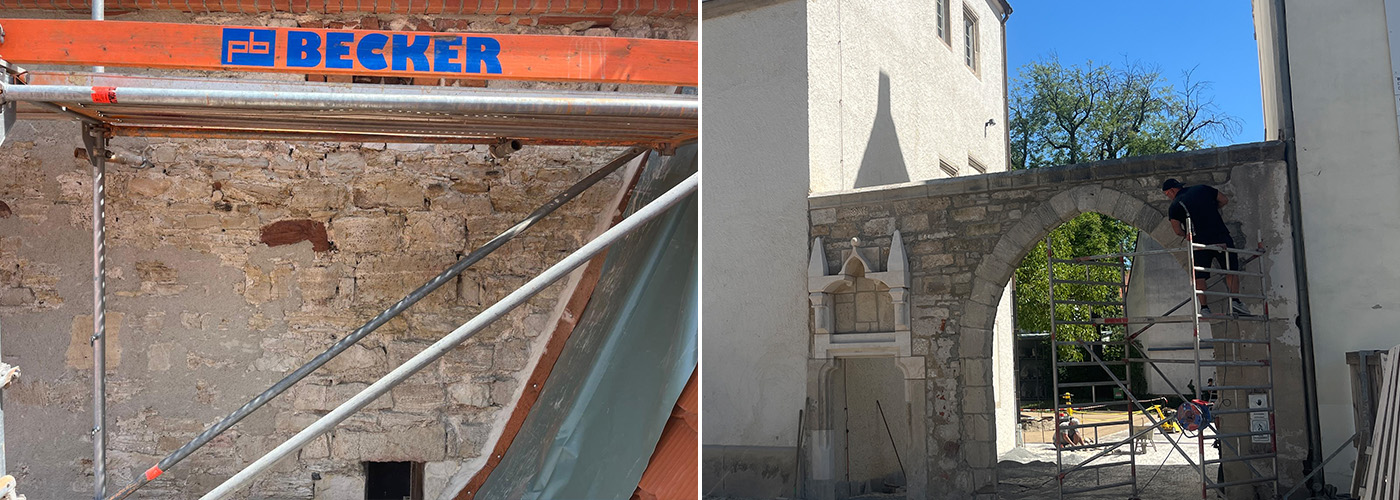
During the restoration of the building’s façade, the aim was to recreate the appearance and design of the 16th-century Renaissance period using a surviving sample of mortar. The requirement was to use a binder from the relevant period and to achieve the colour of the render by selecting the correct aggregates and binder. The addition of pigments was rejected.
Lime plaster system as per sample
The façade was re-plastered in accordance with the heritage conservation guidelines using a mineral lime plaster system. The colour scheme and texture had previously been approved by the heritage conservation authorities in the form of samples.
After cleaning the substrate, it was pre-treated in various ways – by spray-applied rough coat, plaster base coat, etc. – to ensure a crack-free surface. maxit ip 382 purcalc NHL was applied as a base coat to a thickness of 15 mm, thereby achieving the necessary levelling on the various substrates. During periods of high temperatures, these surfaces had to be covered with jute strips and kept damp to ensure the lime plaster set slowly. In areas subject to salt contamination, the porous base plaster maxit san Grund was used in consultation with the heritage conservation authorities. Subsequently, once the curing period had elapsed, the adapted site-specific plaster maxit ip klassik Schleppputz was applied: it was applied to a thickness of 5–8 mm and textured in accordance with the restorers’ specifications. The desired colour was achieved as the material dried.